REINFORCEKiT® 1D – Asia
Composite prepreg solution for coated pipe protection & reinforcement
Overview
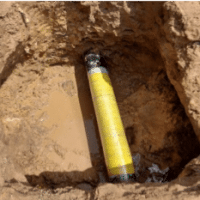
The objective of the repairs, carried out by 3X ENGINEERING's (3X) local distributor, was to reinforce 11 areas of a 200 mm (8″) buried gas pipe suffering from external corrosion. To restore the mechanical integrity of the pipe and prevent further corrosion, it was decided to install the REINFORCEKiT® 1D (R1D) product.
Results
This project was quite complicated because of many COVID restrictions, but our local partner delivered a great job by completing several reinforcements using our REINFORCEKiT® 1D system.
 Defect type |
External corrosion – 11 defects |
Details |
200 mm (8”) buried gas pipe, 40 bars pressure, max. operating temp. 35°C |
Location |
Asia |
3X Product type |
REINFORCEKiT® 1D |
Scope of work
According to the ASME PCC-2 standard and 3X design calculations, it was decided to apply the R1D composite solution (a 3X water-activated composite system dedicated to protecting and reinforcing your pipe). Four layers were determined to reinforce the straight gas line over approx. 2.20 meters total length.
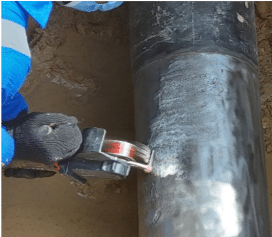
Surface preparation was performed using a Bristle Blaster® machine to remove rust and foreign matter, achieve a good surface roughness (superior to 60 µm Rz), and ensure a good bonding between the steel pipe and the composite repairs. Hygrometric conditions were checked and the surfaces were cleaned with acetone.
The composite wrapping repairs were then completed following the below stages (the installation procedure is the same for the 11 areas to be reinforced):
-
Filler & primer application: F3X8 filler was used to reshape the corroded areas of the pipe. P3X1 primer was then applied over the entire prepared areas.
-
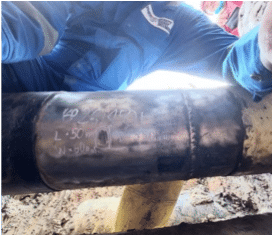
Composite wrapping: Once the "Dry Touch" was reached, composite wrapping was completed by applying 4 layers of R1D for each corroded area. To do so, this water-activated composite system was wrapped around the corroded areas while spraying water continuously.
-
Compression & finalization: Compression film was then rolled all over the wrappings and slightly pierced using a perforating tool (spiked roller). Any trapped CO2 gas bubbles could thus evacuate to get optimal repair laminate quality.